PABLO PICCASO [1881-1973] Spain

1903-1905  Blue Period [sad]
1905-1906  Rosck Period [glade]
1906  Qubism
                                             
''Ladies Of Avignon'' [1907] oil paint in canvas.

MOHANJADARO and HARAPA [3250-2750 BC]

                                      
vally of Sindu  at Pakistan.accomadations of Dravidians
       [ who belived tamils living in south INDIA]

ANCIENT GREEK STATUES 2500-1400 BC

                                                     
 TEMPLE OF PAARTHEENAN 

Sanji Thubi -central INDIA


SAANJI - Hight 54 feet
Jathaka Stories and Statues
                                                               KING  ASOKA
THE BUDDIST CENTRE  Period of ASOKA  -to 11th cen.AC

old one rupees

File:Rupee One - Obverse.jpg 
one-rupee note

Bhimbetka rock old painting

File:Bhimbetka.JPG 

                                      Bhimbetka rock painting, Madhya Pradesh, India.
Analysis of mtDNA dates the immigration of Homo sapiens to South Asia to 70,000 to 50,000 years ago. An analysis of Y chromosome haplogroups found one man in a village west of Madurai to be a direct descendant of these migrators. These populations spread further to Southeast Asia, reaching Australia by 40,000 years ago. Cave sites in Sri Lanka have yielded the earliest record of modern Homo sapiens in South Asia. They were dated to 34,000 years ago. (Kennedy 2000: 180). For finds from the Belan in southern Uttar Pradesh radio carbon data have indicated an age of 18-17kya. Palaeolithic rock art is also well-known.
At the Rock Shelters of Bhimbetka humans lived throughout the Upper Paleolithic (10th to 8th millennia BC), revealing cave paintings dating to ca. 7000 BC; the Sivaliks and the Potwar (Pakistan) region also exhibit many vertebrate fossil remains and paleolithic tools. Chert, jasper and quartzite were often used by humans during this period.

old Coin of Portuguese 1882

File:IPT001.JPG 
Coin of Portuguese India, one rupia of 1882.

1/2 anna old coin of Gwalior

http://upload.wikimedia.org/wikipedia/commons/a/a4/GWR004.JPG 
1/2 anna coin of Gwalior, Indian princely state, 1942

Akbar old coins

File:India - Moghul empire - Akbar - coin of Gobindpur mint.JPG  
Moghul empire - Akbar - coin of Gobindpur mint


Chandragupta II old coins

File:ChandraguptaII.JPG 
Coins of Chandragupta II

Samudragupta old coins

File:SamudraguptaCoin.jpg 
Coin of Samudragupta with Garuda pillar

old coins

File:SungaCoin.JPG 
Cast bronze ½ karshapana coin of the Sunga period (2nd-1st century BC)

old coins

File:MauryanCoin.JPG  

elephant and the sun on Mauryan coins.


old coins

File:VarahaVishnuAvatarPratiharaKings850-900CE.jpg 
 Varaha Vishnu Avatar Pratihara Kings850-900 old coins

Mughal Empire 1526–1857


File:Dagger horse head Louvre OA7891.jpg
A dagger from the Mughal Empire with hilt in jade, gold, rubies and emeralds. Blade of Damascene_steel inlaid with gold


A panorama in 12 folds showing the procession of the last Mughal Emperor Bahadur Shah II to celebrate the feast of the Eid ul-Fitr in 1843.


The Mughal Emperor Shah Alam II negotiates territorial changes with a representative of the British East India Company after the Battle of Buxar.


Mir Sayyid Ali, writing a commentary on the Quran, during the reign of the Mughal Emperor Shah Jahan.


 A silver coin made during the reign of the Mughal Emperor Alamgir II.


 File:Street Scene in India.JPG 
 Mughal troopers purchase copper utensils in the Bazaar


.
File:Taj Mahal 2012.jpg
Mughal, Ottoman and Safavid architectural concepts were incorporated into the design of the Taj Mahal


File:Weeks Edwin Lord Royal Elephant.jpg 
 A Mughal War elephant guarding the gateway to the Grand Mosque in Mathura.


File:Weeks Edwin Lord An Open-Air Restaurant Lahore.jpg 
 The Bazaar outside the Wazir Khan Mosque in Lahore.


Old And Rare Dollar Bills

 
Old And Rare Dollar Bills

Maijishan Grottoes


                               Maijishan Grottoes in China
                                                   History

The Maijishan Grottoes  a series of 194 caves cut in the side of the hill of Majishan in Tianshui, Gansu Province, northwest China. This example of rock cut architecture contains over 7,200 Buddhist sculptures and over 1,000 square meters of murals. Construction began in the Later Qin era (384-417 CE).
Maijishan Mountain is placed on the first list of state key scenic spots by its peculiar grottoes, exquisite clay sculptures luxuriant vegetation, all kinds geologies and landforms, mountain peaks. Its main area is 142km2 including Maijishan Grottoes, the Immortal Cliff, the Stone Gate, Quxi Stream and Jieting Hot Spring. Maijishan Grottoes was first built in Later Qin (384-417.D) constructed successively during the 12 dynasties which are West Qin, Northern Wei, West Wei, Northern Zhou, Sui, Tang, Five Dynasty, Song, Yuan, Ming and Qing. Although many earthquakes and conflagration, it still remains 194 caves, 7200 sculpture, 1000 square M fresco which are excatived on the cliff about 30-80m high form the ground, more than 70 percent caves were excavated in the North dynasty. When clay sculpture were popular, well-shaped and excellent art, They reach the climax of sculpture works in early period. Qinling chains in scenic area are the main boundary between North and South nature geography. There are two plant areas, China-Japan, China-Himalayas areas. They include much kind of plants of North China, Central China, and Himalayas.
Menxinduo Higher plant 223 genera, 873 categories, 2738 species, of which bryophyte plant has 53 genera, 98 categories, 138 species, pteridophyte 21 genera, 43 categories, 92 species, angiosperm 141 genera, 712 categories, 2456 species, gymnosperm 8 genera, 20 categories, 48 species. Preserving Xyophyta 20 species including metase quoia, kinkgo, white bark pine etc. the rare key protected plant listed by state has 31 species, (1 level 1 species, 2 level 7 species, 3 level 23 species), forestation coverage reaches 76% wild animal, birds 12 classes, 34 genera, 95 species, beast 6 classes, 18 genera, 29 species, the rare animals protected by state, 6 classes.7 genera, 18 species.
The scenic spots lies in the joint of QiLian-North Qinlin chains. It forms very complicated geologies and landforms due to movement in Yinzi, Yanshan, and Himalayas. Hot Spring and Quxi Stream is metamorphic rock. Maiji Mountain, the lmmortal clitt, is purple red sandstone rock, while the Stone Gate granite. They have different geology and landform in small area, the abundant forest and flower, the stream and waterfall compose of over 180 scenic spots. They show landscape abundance and variety. The reason of protuberant globular valve: The grottoes kept its fine sculpture of 12 feudal dynasties. It possesses large-scale sculpture museum with 1600 years. It provides precious material studding sculpture, painting, arts and crafts, architecture and religion such as Buddhism. The constructed cave in North Wei (408-534A.D) play an important role for its long history in China even in the world, well preserved well shaped, lively figure. There are biggest palace--shaped building in northern dynasties of Chinese grottoes in these 21 grottoes.
Bulding in wall--painting, skill methods and completed methods are both the best important and valuable works. This abundant building material in northern dynasties is the most precious and important illustration in studying grottoes' nationalism, ancient construction, and freseo. There are about 2738 higher vegetation in the scenic spot, of which 60 genus the 3rd Age xylophta 20 genera, the rare vegetation 31 and 18 genera rare animal protected by State. There is such abundant biology in warm temperature Zone of 34 N latitude; its varieties have typical significance. Maijishan Plant is accepted as member by IUCN. Spectacular Maiji peak, exquisite clay carving temple building under cliff, peculiar landform, about plant clear stream and waterfall combine naturally made up a harmonious landscape of mankind and nature.
 

Winter Palace


Winter Palace, St. Petersburg, Russia
History
From the 1760s onwards the Winter Palace was the main residence of the Russian Tsars. Magnificently located on the bank of the Neva River, this Baroque-style palace is perhaps St. Petersburg’s most impressive attraction. Many visitors also know it as the main building of the Hermitage Museum. The green-and-white three-storey palace is a marvel of Baroque architecture and boasts 1,786 doors, 1,945 windows and 1,057 elegantly and lavishly decorated halls and rooms, many of which are open to the public.
The Winter Palace was built between 1754 and 1762 for Empress Elizabeth, the daughter of Peter the Great. Unfortunately, Elizabeth died before the palace’s completion and only Catherine the Great and her successors were able to enjoy the sumptuous interiors of Elizabeth’s home. Many of the palace’s impressive interiors have been remodeled since then, particularly after 1837, when a huge fire destroyed most of the building. Today the Winter Palace, together with four more buildings arranged side by side along the river embankment, houses the extensive collections of the Hermitage. The Hermitage Museum is the largest art gallery in Russia and is among the largest and most respected art museums in the world.
The museum was founded in 1764 when Catherine the Great purchased a collection of 255 paintings from the German city of Berlin. Today, the Hermitage boasts over 2.7 million exhibits and displays a diverse range of art and artifacts from all over the world and from throughout history (from Ancient Egypt to the early 20th century Europe). The Hermitage’s collections include works by Leonardo da Vinci, Michelangelo, Raphael and Titian, a unique collection of Rembrandts and Rubens, many French Impressionist works by Renoir, Cezanne, Manet, Monet and Pissarro, numerous canvasses by Van Gogh, Matisse, Gaugin and several sculptures by Rodin. The collection is both enormous and diverse and is an essential stop for all those interested in art and history. The experts say that if you were to spend a minute looking at each exhibit on display in the Hermitage, you would need 11 years before you’d seen them all. However, we recommend you opt for a guided tour instead!


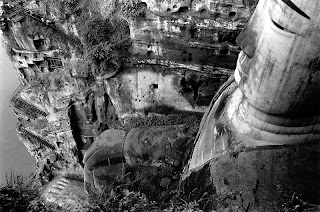
Buddha Statue in Leshan


                               Buddha Statue leshan in china
                                                                             
                                                             History
   The Leshan Giant Buddha (simplified Chinese: Lesha-n Dafo) was built during the Tang Dynasty (618–907AD). It is carved out of a cliff face that lies at the confluence of the Minjiang, Dadu and Qingyi rivers in the southern part of Sichuan province in China, near the city of Leshan. The stone sculpture faces Mount Emei, with the rivers flowing below his feet. It is the largest carved stone Buddha in the world and it is by far the tallest pre-modern statue in the world. The Mount Emei Scenic Area, including Leshan Giant Buddha Scenic Area has been listed