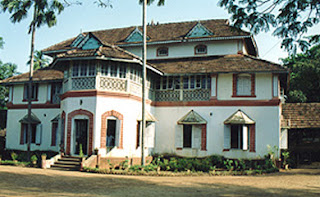
Hill Palace


Hill Palace Thripunithura, Ernakulam District, Kochi
History 
Hill Palace  is located in Thripunithura/Tripunithura, in Ernakulam district of the state of Kerala. Constructed in 1865, the museum (previously a palace) used to be the official residence of the Kochi Royal family. The palace has now been converted into the present day museum. The museum holds the collection of the paintings of the erstwhile Maharaja of Kochi. The palace complex is a large enclosed area which comprises of 49 buildings, which were built in traditional Kerala style architecture. The palace compound is spread over 52 acres of area. This compound includes beautiful fountains which are a piece of art. Apart of these fountains the compound also guards elaborately lush lawns and a number of ponds. There are a number of rare medicinal plants too, which have been cultivated here. The Ethno-archaeological museum displays a number of ancient murals, oil-paintings, Stone artifacts and coins, along with manuscripts and sculptures, which belongs to the Kochi Royal Family. The first building constructed inside the complex is a single storied Ettukettu, which is supposed to be constructed in the year 1850. There is a traditional pond and a temple alongside this building. This building is constructed in traditional Kerala architecture style, according to which a residential building should be added with a pond and a temple. The latest addition to the palace compound is the three-storey museum office, which was constructed in the year 1950 in western style.  The palace was announced as a historical site and was taken over by the Department Of Archaeology in the year 1980. Six years later in 1986, the palace was opened to public. However, the museum was closed to public during the time, because rigorous renovation works were taking place. The palace was almost rebuilt and major changes were done to the exteriors of the compound. The palace was fitted with intricate carvings, which add to the ambiance of the palace. The palace is elaborately designed, while the museum is divided into 14 different categories of exhibits, including inscriptions, paintings, murals, manuscripts, sculpture in stone and plaster of Paris, carvings etc. This palace is one of the major examples of Nalukettu form of architecture, which was appreciated in Kerala at the medieval times and is still valued.  

Maritime Museum


Maritime Museum Cochin, Kerala
History 
India has a strong naval fleet. Its armada is deemed as one of the top marine squads in theworld. This depends upon the physical and technical prowess of our navy men. The Maritime Museum at Cochin  Kochi (Kerala) is devoted to such maritime potential of India. The museum celebrates the devotion, bravery and selfless services delivered by thevaliant gentlemen of Indian fleet. Situated at INS Dronacharya in Kochi, Maritime Museum displays the origin, growth and chronology of the Indian Navy. The Maritime     Museum at Cochin displays not only the accomplishments of the Indian fleet, but also the representations of some fundamental sailing ploys. These were used by the ancient and medieval sailors during the times when the Indian Navy was not-existent and the Indian coastline was guarded by the kings with the help of a well equipped and trained military force
Maritime Museum Kochi also displays certain evidences that testify the trade relations between the natives of Kerala and the late settlers of Indus Valley Civilization. There are a few displays stored inside the museum which support Kerala's claim of having trade links with the Arabs via sea, Indian Naval influence in South East Asia and the colonization of India by European powers in the medieval period.  
Another interesting thing about the Maritime Museum of Cochin is that it exhibits ship building activities. These activities bring forward some interesting facets of ship building in India. Exotic vessels and boats are put on display in this section of the museum. Here, a 300-year old boat of the King of Ambalapuzha is also put on display. The boat is carved out of a single tree, which exemplifies the ship building style of the medieval period. The boat is an exquisite example of the mastery of Indians in shipbuilding, which helped in spreading Indian culture to the islands of Java, Sumatra and Bali. These examples date to the 3rd century BC and the 12th century AD.

A complete section of Cochin Maritime Museum highlights the stories of Indian Navy's glory, whenever it took on its aggressors and ultimately won almost all the battles on water. Other sections stress particularly on the valor and bravado of the Indian armada, which has taken place from the geneses of the Indian Navy till present. The visitors of the museum are enlightened by the artifacts, each of which tell the story of evolution of the Indian Naval power from the year 1612, when the Indian Marine was established in Surat. A number of operations and battles are comprehended here, a few of which include the Goa liberation, Junaghad operation, Operation Cactus, Operation Pawan Indo-Pak conflicts of 1965 and 1971, and the tactical drills during the Kargil war. An exclusive hall is dedicated to bravery and strategies in the memory of Kunjali Marakkar which is a legendary name in the history of Indian maritime. He was the most glorious wartime hero ever in history of Indian Navy.
 

Archaeological Museum


Archaeological Museum Thrissur Kerala
History 
Archaeological Museum situated in the city of Thrissur, Kerala, is a part of the state zoo compound. The archaeological gallery was attached to the already existing art gallery, in the year 1948. Later, the galleries were shifted to a new building in the year 1975. With time, the museum has accumulated a large collection of diverse artifacts. For instance, it preserves a number of life size statues of famous and eminent personalities like tribal chiefs, famous artists, kings, freedom fighters and reformers etc. Highly detailed and intricately crafted models of old buildings and temples are also conserved here and it also preserves manuscripts from the past which contains the history of Kerala.

These manuscripts exhibited in the Archaeological Museum Trichur are preserved with great care, as these are made of highly vulnerable dried palm leaves. The museum also stores a large number of artifacts, which were found from the jungles of Thrissur and Wayanad district. One of the major possessions of the Archaeological museum is a rare assortment of ‘Veerakallu’ or stone engravings and carvings, along with an atypical collection of megalithic weapons which were excavated from the forests of Wayanad and Thrissur. Other items which are showcased along with this exquisite collection include a gigantic anthology of Stone Age tools, megalithic wares and pottery, russet coated wares, urn burials, items excavated from north Indian civilizations like Harappa and Indus Valley Civilization. One can also find stone sculptures as old as 7th century and bronze sculptures dating back to the 10th century, here. Materials that have been excavated from Nenmeni Village, near Kollengode, are also displayed at the Archaeological Museum of Thrissur.

The building of Archaeological Museum Trichur was constructed by the king of Kollengode, for his daughter, in the year 1904. The building displays an exclusive merger of customary Kerala architecture and Western architecture. The history comes alive in the museum, in the form of paintings and sculptures. One can get a glimpse of the vibrancy of the culture, religion, performing arts, architecture and literature of the state, through these paintings and sculptures. The archaeologists regard this museum as one of the most accomplished museums in India, in terms of the accessibility to the artifacts and the typical diversity of those. The museum is home to the largest assortment of megalithic remains in Kerala. The environs of the museum are covered with thick vegetation that adds to the charm of the museum’s location. It is maintained and retained by the State Archaeology Department of Kerala. 

Tetradrachma of Seleucus

 
Tetradrachm of Seleucus I
Money—as a means of exchange, a mode of payment, and a standard of value—was in use in the ancient Near East long before the invention of coinage in Lydia during the seventh century B.C. Early Mesopotamian texts record payments of silver weighed in shekels (about 8.3 grams), minas (about 500 grams), and talents, or donkey-loads (about 30 kilograms), but the value of objects was also converted into equal-value weights of grain, copper, and tin. The connection between money and weight continued in coins; a drachm, for example, weighed about 4.3 grams, a tetradrachm (4 drachms) about 17 grams.  The obverse of this tetradrachm displays an idealized portrait of Seleucus I (r. 312–280 B.C.) wearing a helmet covered with a leopard skin and adorned with a bull's ear and horns. Around Seleucus' throat is another leopard skin, knotted in front by means of the beast's forepaws. The features of Seleucus resemble those on coins showing Alexander the Great and with whom the new Macedonian rulers wished to be compared. The reverse of the coin has a winged, fully draped figure of Nike (Victory) standing on the right. She holds a wreath in her upraised hands, apparently about to place it upon a trophy of arms comprising a helmet, cuirass (a breast- and backplate) with leather straps and skirt, and a star-adorned shield. All the arms are hung upon a large tree trunk, from the lower part of which springs a leafy branch. It has been suggested that this symbolizes the Battle of Ipsus, fought in 301 B.C., in which Seleucus was victorious against his rival Antigonus. The inscription reads "Seleucus" and "Basileus" (king).
Under Seleucus I, coins were minted at a number of cities throughout his empire. This example was minted at Persepolis, the administrative center in Persia, where it was excavated by the British Institute of Persian Studies.


Arakkal Palace


Arakkal Palace Ayikkara, Kannur, Kerala
                                                                    
                                                                             History 
Arakkal Palace belonged to the Arakkal Royal family, the only Muslim royal family in Kerala. In 1663, Arakkal ruler also purchased St. Angelo Fort from the Dutch. The Arakkal rulers had control over the northern coastal region of Kerala and Lakshadweep. The Arakkal family used to accept the eldest member of the family, irrespective of gender, as the ruler of the province. ?Ali Rajah? was the name given to the male rulers of the Arakkal family, while their female counterparts were called ?Arakkal Beevis?. By 1870, the British seized the fort and built their military base on the Malabar Coast. They also carried the construction of a tunnel connecting the Fort, with Thalassery Fort, located at a distance of 21 km from Kannur Fort. This tunnel used to come in handy at the time when the enemies used to attack. The major residents were transported to another location through this tunnel.

Pagarruyung palace

 
Pagarruyung palace.Batusangkar, Indonesia. 
History
Adityawarman is believed to have founded the kingdom and presided over the central Sumatra region between 1347 and 1375, most likely to control the local gold trade. The few artifacts recovered from Adityawarman’s reign include a number of stones containing inscriptions, and statues. Some of these items were found at Bukit Gombak, a hill near modern Pagarruyung, and it is believed a royal palace was located here.
There is a major gap in the historical picture in the Minangkabau highlands between the last date of Adityawarman’s inscription in 1375 and Tomé Pires Suma Oriental, written sometime between 1513 and 1515.
By the 16th century, the time of the next report after the reign of Adityawarman, royal power had been split into three recognized reigning kings. They were the King of the World (Raja Alam), the King of Adat (Raja Adat), and the King of Religion (Raja Ibadat). Collectively they were called the Kings of the Three Seats (Rajo Tigo Selo).
The first European to enter the region was Thomas Dias, a Portuguese employed by the Dutch governor of Malacca. He traveled from the east coast to reach the region in 1684 and reported, probably from hearsay, that there was a palace at Pagaruyung and that visitors had to go through three gates to enter it. The primary local occupations at the time were gold panning and agriculture, he reported.

windsor castle

 
windsor castle in london
                                                                      History
Windsor Castle is the oldest and largest occupied castle in the world.
Over a period of nearly 1,000 years it has been inhabited continuously, and altered and refurbished by successive monarchs. Some were great builders, strengthening the Castle against uprising and rebellion; others, living in more peaceful times, created a palatial Royal residence.

William the Conqueror chose the site, high above the river Thames and on the edge of a Saxon hunting ground. It was a day's march from the Tower of London and intended to guard the western approaches to the capital.
The outer walls of today's structure are in the same position as those of the original castle built by William the Conqueror in the 1070s. So too is the central mound supporting the Round Tower and the Upper Ward, where successive monarchs have had their private apartments since the fourteenth century.
In the 1170s Henry II rebuilt - in stone instead of wood - the Round Tower, the outer walls of the Upper and most of the Lower Ward, and the Royal apartments in the Upper Ward.
In the 1360s Edward III, who was born at Windsor, extended the Castle. He created the immense St. George's Hall for the use of the Knights of his newly founded Order of the Garter.
St George's Chapel was begun by Edward IV (r. 1461-70 and 1471-83) and completed by Henry VIII. It is dedicated to the patron saint of the Order of the Garter, Britain's highest order of chivalry, and ranks among the finest examples of late medieval architecture in Western Europe.

Ten British monarchs lie buried in the chapel: Edward IV, Henry VI, Henry VIII, Charles I, George III, George IV, William IV, Edward VII, George V and George VI.
Oliver Cromwell captured Windsor Castle after the Battle of Edgehill in 1642, and for the rest of the Civil War it became a prison as well as the headquarters of the parliamentary forces.

In 1648 Charles I was held there before his trial and execution in London; his body was brought back for burial in St. George's Chapel during a snowstorm.

Following the Restoration, Charles II was determined to make the Castle as splendid as possible. He created a new set of State Apartments in the 1670s, using the skills of the architect Hugh May, the artist Antonio Verrio for murals and ceiling paintings, and the famous wood-carver Grinling Gibbons.

The King's Dining Room and the Queen's Presence and Audience Chambers retain many of these original features. Charles II also laid out the 5km Long Walk leading due south from the Castle into Windsor Great Park.

George IV was a great lover of art and fine decoration. Much of Windsor Castle's present appearance is due to the alterations he instigated in the 1820s with his architect, Sir Jeffry Wyatville. The buildings were refashioned in the Gothic style, with the addition of crenellations, turrets and towers.

In the Upper Ward the private apartments were moved from the north side of the quadrangle to the south and east side. The rooms on the north side were designated, as now, as for use on formal occasions and State visits.
One of George IV's most remarkable additions was the Waterloo Chamber, which was created in the 1820s to show portraits commissioned from Sir Thomas Lawrence to commemorate the defeat of Napoleon at the battle of Waterloo in 1815.

They represent the monarchs, soldiers and statesmen who were involved in that defeat and its aftermath. They include George III, George IV and the future William IV, the Duke of Wellington, Field Marshal von Blücher, the Emperors of Austria and Russia, the Kings of Prussia and France, and Pope Pius VII.
Queen Victoria and Prince Albert were devoted to Windsor, where they spent much of their time. It was during the reign of Queen Victoria that, in 1845, the State Apartments were first opened to the public.

Prince Albert died of typhoid at Windsor in 1861 and was buried in a spectacular mausoleum that Queen Victoria constructed at Frogmore in the Windsor Home Park.

During the Second World War, Windsor Castle was home to the young Princesses Elizabeth and Margaret Rose while their parents supported the war effort in London and around the country. Today The Queen uses the Castle regularly, spending most of her weekends there.
The twentieth-century history of the Castle is dominated by the major fire that started on 20 November 1992. It began in the Private Chapel, when a spotlight came into contact with a curtain and ignited the material.

It took 15 hours and one-and-a-half million gallons of water to put out the blaze. Nine principal rooms and over 100 other rooms over an area of 9,000 square metres were damaged or destroyed by the fire, approximately one-fifth of the Castle area.

The next five years were spent restoring Windsor Castle to its former glory. It resulted in the greatest historic building project to have been undertaken in this country in the twentieth century, reviving many traditional crafts.

The restoration was completed six months ahead of schedule on 20 November 1997 at a cost of £37 million (US $59.2 million), £3 million below budget. Seventy per cent of the necessary revenue was raised from opening Buckingham Palace's State Rooms to visitors in August and September.

The remaining 30 per cent of the cost was met from savings in the annual Grant-in-Aid funding from Parliament for the maintenance and upkeep of the occupied Royal Palaces. The restoration was undertaken at no additional cost to the taxpayer.

To mark the completion, The Queen and The Duke of Edinburgh held a 'thank you' reception in the restored rooms on 14 November 1997 for 1,500 contractors. On 20 November that year they celebrated their Golden Wedding Anniversary with a ball also held at Windsor Castle.

Dolmabahce Palace

 
Dolmabahce Palace Istanbul, Turkey
Dolmabahace` actually means `the filled garden`. The Palace is built on land reclaimed from the Bosphorus, hence it got its name of Dolmabahace. The famous painter Melling visited Istanbul during the reign of Sultan Mahmut II and the wooden palace, which originally stood there, is represented in many of his prints. After Mahmut II, Sultan Abdulmecit came to stay there and he ordered the palace to be rebuilt in a western fashion, giving its present form. He employed the services of the Armenian architect Nikogos Balyan to complete this enormous task, which was completed between 1843 and 1856.

The affluence of the western world brought by Industrial revolution had influenced Abdulmecit to adopt a lavish lifestyle. From that perspective, the Dolmabahce Palace was a true reflection of the times in its splendor and glamour.

Sultan Abdulmecit shifted to the Dolmabahce Palace permanently with his family from the original residence of Turkish monarchy in Topkapi Palace. However, unfortunately, this was also an example of the wasteful expenditure that brought about the gradual decline of the Turkish Empire. Sultan Abdulmecit died at a rather young age of tuberculosis and his successor Abdulaziz was dethroned in 1876 because of his extravagance and despotism. He ultimately was retired to a simple palace at Ortakoy. Later Kemal Ataturk, founder of the Turkish Republic, used a small portion of the palace for his residence, but used it mainly as a center for various congresses. 

Royal Palace

 
Royal Palace of Madrid.spain
The site of Madrid has been occupied since prehistoric times, as has been shown by numerous objects found during different excavations along the banks of the River Manzanares. Many of these objects (axes and small Palaeolithic objects, remains of animals that prove the existence of large mammals, Neolithic ceramics, etc.) can be seen at the National Archaeological Museum. Madrid's population was initially Iberian and later Roman, and is possibly the Mantua found in certain ancient references and the Roman Miacum from the "Antonine itinerary", although some historians dispute this.
It is now commonly believed that the original name of the settlement here was Matrice, a pre-Muslim word, which refers to the waters of the area and particularly to the stream running down the Calle de Segovia.
However, Madrid as such does not achieve a mention in chronicles until the late tenth century, at which time there was already a fort or castle where the Royal Palace stands today. This fort was occupied by the Moors, who having named the River Manzanares al-Magrit ("source of water"), referred to the area as Mayrit (from which Magerit, then Madrid) and around which the borough of Madrid developed in the following centuries. The old arab walls surrounding this settlement can still be seen today (more info here).
Between several different warriors, the Moors kept rule until Madrid was finally conquered in 1085 by Alfonso VI in his advance towards Toledo. This king ordered the main mosque within the fort's walls to be "purified" and consecrated as a Catholic church under the guidance of the Virgin of the Almudena, the name deriving from a religious icon found near the "almudín" or wheat deposit. La Virgen de la Almudena later became Madrid's female patron saint, whose saint's day is celebrated on 9th November and who gives her name to Madrid's cathedral.
In the year 1329, King Fernando V assembled The Court of Madrid for the first time.
A little later, due to the Reconquista, Moors and Jews formed a concentrated population in the area that still today carries the name of Morería, but in 1494 the "unbelievers" were expelled and the mosque and other indicative buildings disappeared.
Later, Madrid was taken by the followers of Enrique of Tastamara and ceded by Juan I to King Leon V of Armenia who was then dethroned by the Sultan of Babilonia. Having been destroyed by fire during the reign of Enrique II, the city was rebuilt by his grandson Enrique III, who reincorporated Madrid under the Crown of Castille and who also founded El Pardo, situated just outside the city.
Enrique VI gave Madrid the title of "Very Noble and Loyal" and celebrated here his magnificent wedding with Doña Juana of Portugal. The death of the king caused the formation of two distinct bands within the Castille kingdom - the two sides disputing the succession of the throne. Isabel and her supporters overcame Doña Juana's followers and the victorious "Catholic Kings" (Isabel and her husband Fernando) solemnly entered the city to reside in a mansion in the Plaza de la Paja owned by Don Pedro Lasso de la Vega.
During the war of Communities, the Borough of Madrid took sides with the "Comuneros", although this did not prevent Emperor Carlos V bestowing on the city the title of "Crowned and Imperial". As remnants of these times we can cite the Church of San Jerónimo, the Church of del Paso and the Tower of Lujanes, this last in the Plaza de la Villa, opposite the Ayuntamiento or City Hall where Francis I of France was held prisoner after his defeat at Pravia in Italy.
Carlos V was certainly enamoured with Madrid, amongst other things because he managed to cure himself here of tertian fever. However, it was his son, Felipe II who moved the Imperial Court to Madrid in 1561, although without making any official declaration. The population of the borough at this time was around 25,000. From this time Madrid was now the kingdom's capital, apart from the brief years between 1601 and 1606 when Felipe III installed his court in Valladolid.
Madrid enjoyed significant changes during the 18th century, when city gates, bridges and new buildings gave it a new appearance. The Royal Palace (also called the Eastern Palace - Palacio de Oriente, standing next to the large Plaza de Oriente square) was constructed on the site of the ruins of the Alcazar or old Moorish Castle which had been destroyed by fire in 1734. After 1738 Juan B. Sachetti directed the construction work on the Palace, helped out to some extent by Ventura Rodríguez and developing on original plans made by Juavera. The work was practically completed by 1760.
The reign of Carlos III (1759 - 1788) helped to greatly improve the appearance of the city. The work on the Royal Palace was totally completed (as we know it today), as was the construction of the city gates of Puerta de Toledo, Puerta de Segovia (no longer standing) and Puerta de Alcala, together with the Royal Theatre, the building that now houses the Ministry of Finance (Hacienda), the Natural Science Museum, the Botanical Gardens and the temple of San Francisco El Grande, amongst others. Also, the Retiro Park was significantly improved and several new buildings built: Casa de Cisneros, the General Hospital, the College of San Carlos, the Royal Mint, Casa de los Geranios and the fountains of Cibeles, Neptune and Apollo.
The reign of Carlos IV gave Madrid the Buenavista Palace (today the Ministry of Armed Forces) and other notable mansions such as that of the Dukes of Liria in Princesa Street and that of the Count of Altamira in Calle de la Flor.
On the 2nd of May 1808 a popular revolt started in the Puerta del Sol, initiating the War of Independence. There are numerous place names in Madrid dedicated to these patriotic disturbances, the most significant being of course the Plaza Dos de Mayo in Malasaña. Once General Castaños had repelled the invaders in Bailén, he entered Madrid on 23rd August 1808. However, there were further battles when Emperor Napoleon presented himself in Chamartín and also in December of the same year when José Bonaparte entered Spain, only to be expelled three years later under pressure from the Anglo-Hispanic army led by Wellington. The last of the French left Madrid on the 27th May 1813 and the following year King Fernando VII entered the city.
In 1835 the famous University of Alcalá de Henares was transferred to Madrid, where the Faculty of Science was added, becoming the Universidad Complutense de Madrid.
The city continued to be improved during the reign of Isabel II with old houses in the Puerta del Sol being pulled down and the Congreso de los Diputados or Parliament, Royal and Zarzuela Theatres and the Canal de Isabel II (Madrid's water lifeline) being built. Also, in 1857, Madrid's gas lighting system was inaugurated.
Since then Madrid's urban progress has accelerated to reach, today, the level of one of Europe's most beautiful capital cities - pleasing both for its intense animated spirit and its suitable mix of modern and classical appearance.

Palace of the Parliament


Palace of the Parliament in Bucharest, Romania.

Since 1996, the building has housed Romania's Chamber of Deputies, which had previously been housed in the Palace of the Patriarchy; the Romanian Legislative Council; and the Romanian Competition Council. The Romanian Senate joined them there in 2005, having previously been housed in the former Communist Party Central Committee building. The Palace also contains a massive array of miscellaneous conference halls, salons, etc. used for a wide variety of other purposes.
In 2003-2004 a glass annex was built, alongside external elevators. This was done to facilitate access to the National Museum of Contemporary Art (MNAC) opened in 2004 inside the west wing of the Palace of the Parliament, and to the Museum and Park of Totalitarianism and Socialist Realism, also opened in 2004.
The cafeteria for use of the legislators has been refurbished. Also in the building is the headquarters of the Southeast European Cooperative Initiative (SECI), an organization focused on regional cooperation among governments against cross-border crime.
There are public tours organized in a number of languages.
In 2008, the Palace hosted the 20th NATO summit.